Introduction
Losing body fat is not just about stepping on a scale and watching the number go down. It is about losing the right kind of weight — stored body fat — while holding on to the lean muscle that keeps your metabolism strong, your body looking defined, and your energy levels high.
Whether you are currently sitting at 25% body fat and want to get to 21%, or you are already at 21% and pushing toward a leaner 18%, the approach needs to shift as you progress. What works in Phase 1 will not be enough in Phase 2.
In this complete guide, we cover the three pillars of successful fat loss — diet, training and cardio — and provide two detailed Indian diet plans tailored to each phase of your journey. Each section is designed to be infographic-ready, so you can take these frameworks and bring them to life visually on your blog or social platforms.
The Three Pillars of Fat Loss
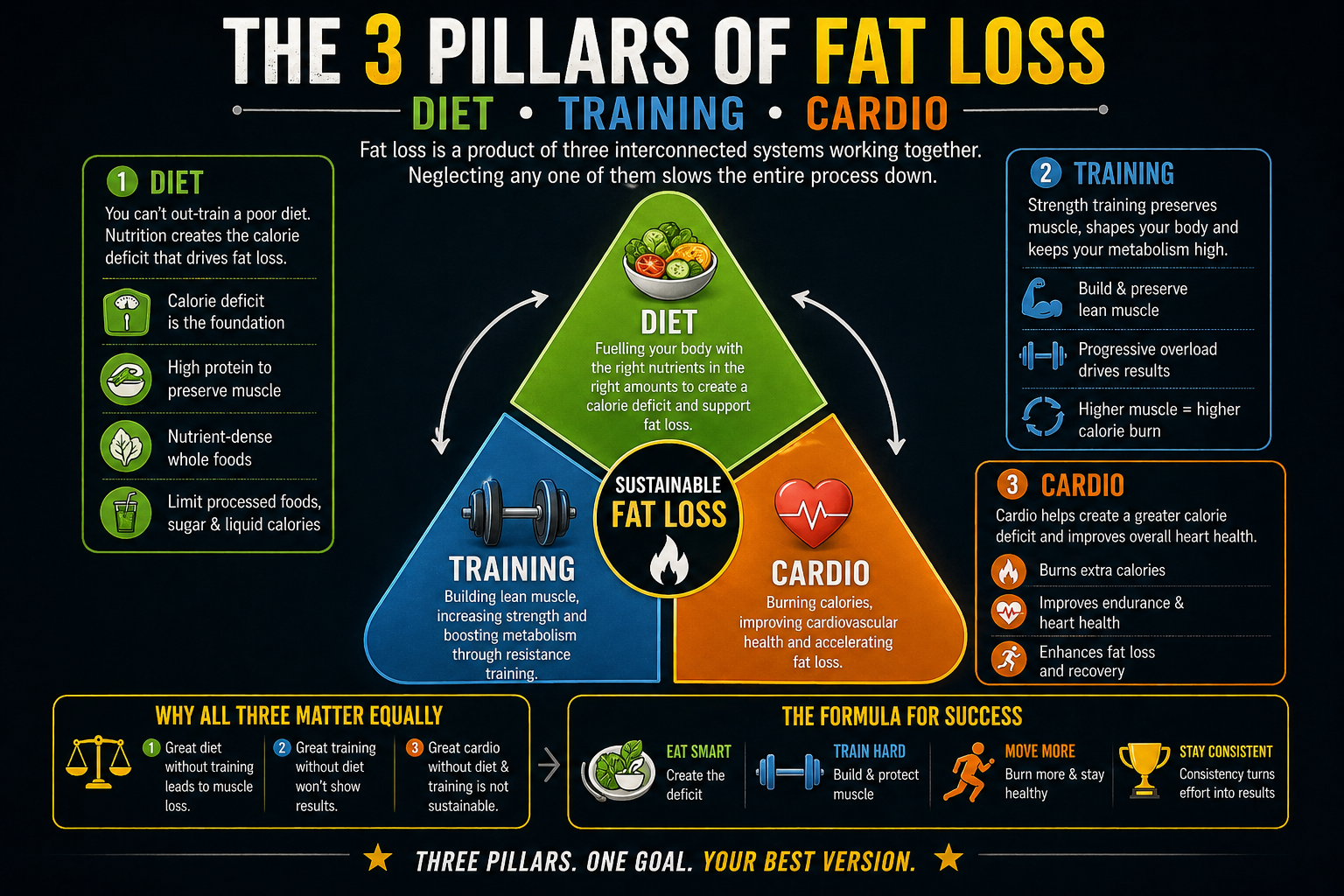
Fat loss is a product of three interconnected systems working together. Neglecting any one of them slows the entire process down. Here is what each pillar does and why all three matter equally.
Pillar 1 — Diet: Your Fat Loss Foundation (70% of Results)
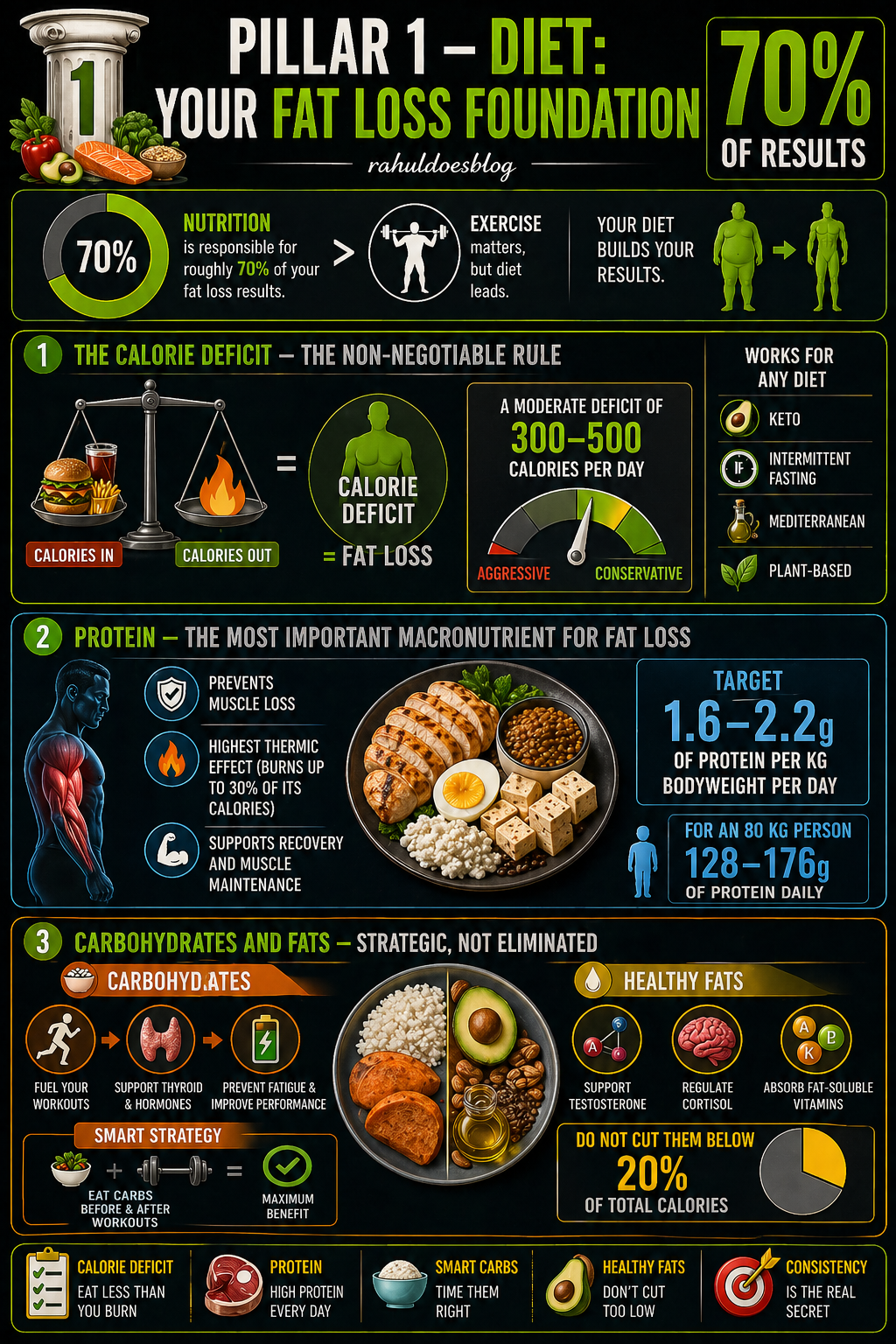
No amount of exercise can outrun a poor diet. Nutrition is responsible for roughly 70% of your fat loss results, which is why it is the first and most important pillar to get right.
The Calorie Deficit — The Non-Negotiable Rule
Fat loss has one absolute requirement: you must consume fewer calories than your body burns. This is called a calorie deficit. Every diet that works — whether keto, intermittent fasting, Mediterranean or plant-based — works because it creates a calorie deficit, either directly or indirectly.
A moderate deficit of 300 to 500 calories per day is the sweet spot for sustainable fat loss. It is aggressive enough to produce results but conservative enough to preserve muscle mass and keep energy levels stable.
Protein — The Most Important Macronutrient for Fat Loss
When in a calorie deficit, your body is at risk of breaking down muscle tissue for energy. Protein prevents this. It also has the highest thermic effect of any macronutrient — meaning your body burns up to 30% of protein’s calories just digesting it.
Target: 1.6 to 2.2 grams of protein per kilogram of bodyweight per day.
For an 80 kg person, this means consuming 128 to 176 grams of protein daily.
Carbohydrates and Fats — Strategic, Not Eliminated
Carbohydrates fuel your workouts and keep your thyroid and hormones functioning optimally. Cutting them completely often leads to fatigue, poor training performance and hormonal disruption. Instead, time your carbs around your workouts — consume them before and after training for maximum benefit.
Healthy fats support testosterone, cortisol regulation and fat-soluble vitamin absorption. Do not cut them below 20% of total calories.
Add Your Heading Text Here
Pillar 2 — Training: Build the Body That Burns Fat
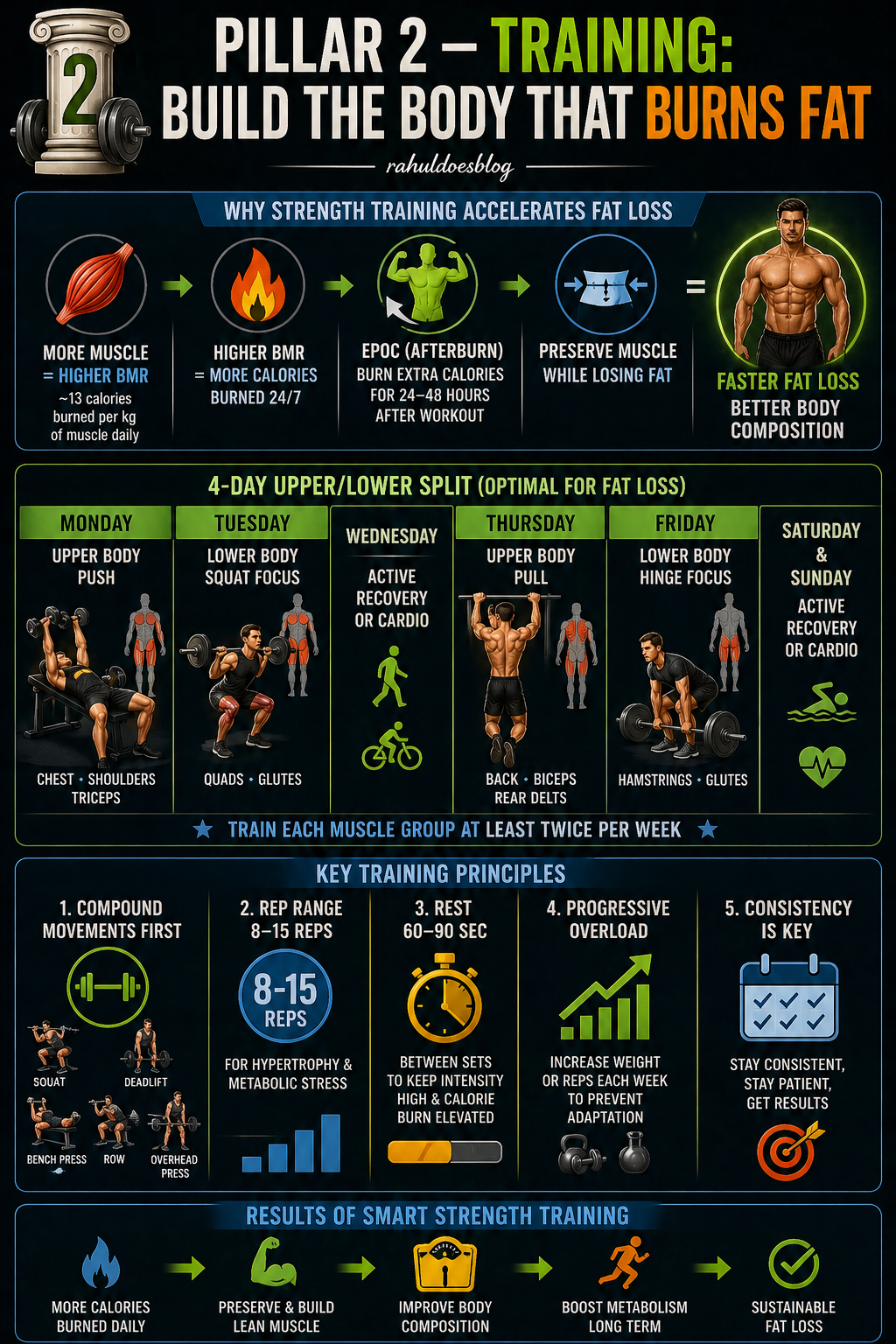
Many people trying to lose fat focus exclusively on cardio and skip resistance training entirely. This is one of the most costly mistakes in fat loss. Here is why strength training is essential for fat loss, not optional.
Why Strength Training Accelerates Fat Loss
Every kilogram of muscle tissue on your body burns approximately 13 calories per day at rest. By building and preserving muscle through resistance training, you raise your Basal Metabolic Rate (BMR) — the number of calories your body burns doing nothing. This creates a compound fat-burning effect that persists 24 hours a day, seven days a week.
Resistance training also creates a powerful post-workout effect called EPOC (Excess Post-Exercise Oxygen Consumption) — commonly referred to as the “afterburn effect.” After a hard strength session, your body continues burning elevated calories for up to 24 to 48 hours.
Recommended Training Split for Fat Loss
The following split works for both phases of fat loss covered in this article:
4-Day Upper/Lower Split:
- Monday: Upper Body — Push (Chest, Shoulders, Triceps)
- Tuesday: Lower Body — Squat focus (Quads, Glutes)
- Thursday: Upper Body — Pull (Back, Biceps, Rear Delts)
- Friday: Lower Body — Hinge focus (Hamstrings, Glutes)
- Wednesday, Saturday, Sunday: Active recovery or cardio
Key Training Principles:
- Train each muscle group at least twice per week for maximum muscle retention during a deficit
- Use compound movements first — squats, deadlifts, bench press, rows, overhead press
- Keep rep ranges between 8 and 15 for hypertrophy and metabolic stress
- Rest 60 to 90 seconds between sets to keep intensity high and calorie burn elevated
- Progressive overload — increase weight or reps each week to prevent adaptation
Pillar 3 — Cardio: The Accelerator, Not the Engine
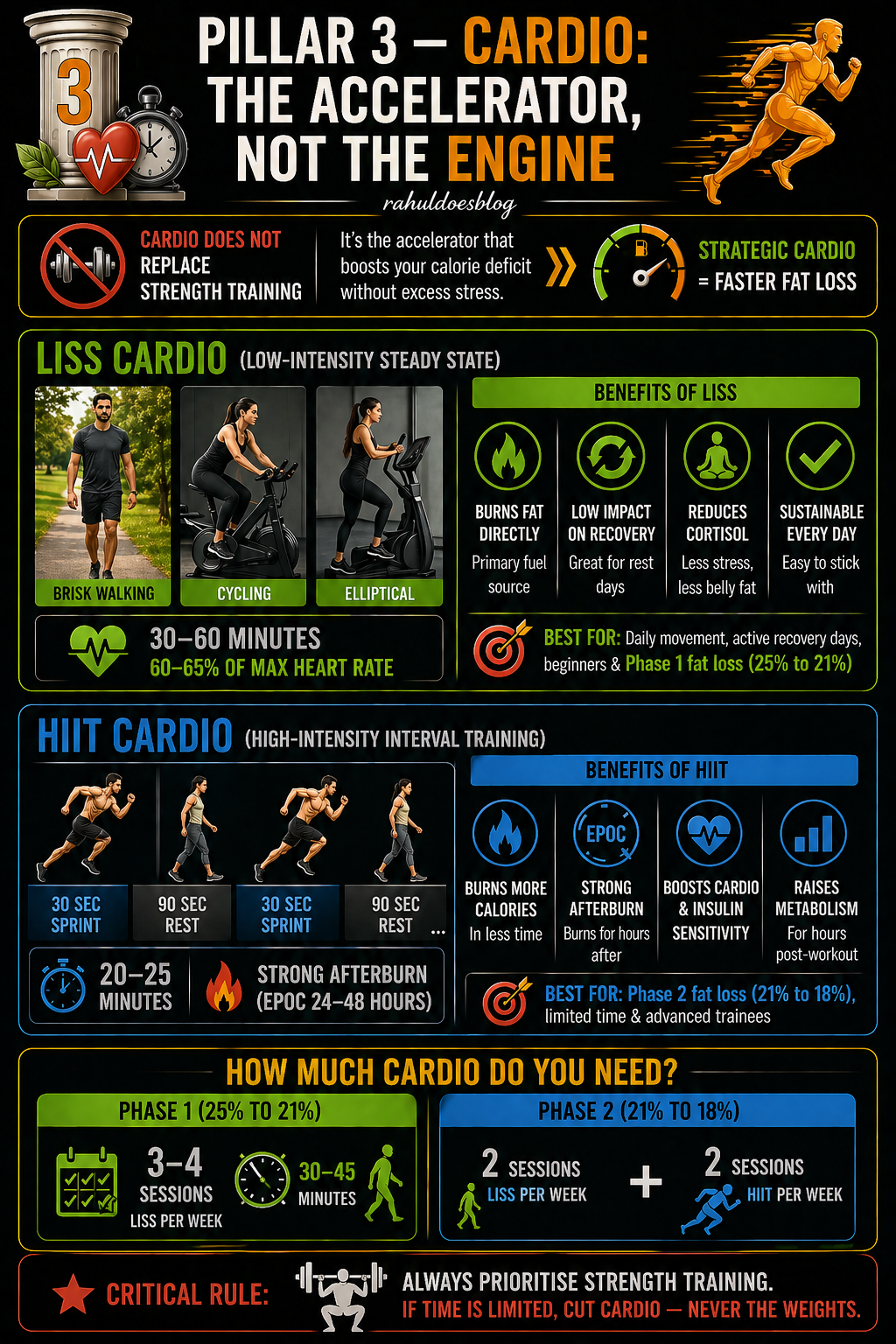
Cardio does not burn as many calories as most people believe, and it should never replace strength training in a fat loss programme. However, used strategically, it is a powerful tool to accelerate the calorie deficit without adding excessive recovery stress.
LISS Cardio (Low-Intensity Steady State)
LISS involves sustained, moderate-intensity exercise maintained for 30 to 60 minutes. Think brisk walking, cycling at a comfortable pace, or using the elliptical at 60 to 65% of maximum heart rate.
Benefits of LISS:
- Burns fat directly as the primary fuel source at low intensity
- Minimal impact on recovery — can be done on rest days
- Reduces cortisol (the stress hormone that promotes belly fat storage)
- Sustainable every day without burning out
Best for: Daily movement, active recovery days, beginners and Phase 1 fat loss (25% to 21%)
HIIT Cardio (High-Intensity Interval Training)
HIIT alternates between short bursts of maximum effort and brief recovery periods. A typical session lasts just 20 to 25 minutes but produces a powerful EPOC effect that continues burning calories for hours afterward.
Benefits of HIIT:
- Burns significantly more total calories in less time
- Creates a strong afterburn effect (EPOC)
- Improves cardiovascular fitness and insulin sensitivity rapidly
- Raises metabolism for hours post-exercise
Best for: Phase 2 fat loss (21% to 18%), those with limited time, advanced trainees
How Much Cardio Do You Need?
- Phase 1 (25% to 21%): 3 to 4 sessions of LISS per week, 30 to 45 minutes each
- Phase 2 (21% to 18%): 2 sessions LISS + 2 sessions HIIT per week
Critical rule: Always prioritise strength training. If time is limited, cut cardio — never the weights.
Putting All Three Pillars Together
The real power of fat loss does not come from doing any one of these pillars perfectly. It comes from doing all three of them consistently and letting them work together as a system.
Think of it this way:
Diet creates the deficit. Training preserves and builds the muscle that keeps your metabolism elevated. Cardio accelerates the process by burning additional calories without interfering with your recovery.
Remove diet and you have no deficit — no fat loss happens regardless of how hard you train. Remove training and you lose muscle alongside fat, slowing your metabolism and making the results short-lived. Remove cardio and progress becomes slower and harder to sustain as you get leaner.
When all three work together, the results compound week after week.
Where Do You Start?
If you are completely new to structured fat loss, do not try to overhaul everything at once. The most common reason people fail is not lack of knowledge — it is attempting to change too much too soon and burning out within two to three weeks.
Follow this simple three-week ramp-up:
Week 1 — Fix the diet. Calculate your maintenance calories, subtract 400 and hit your protein target every single day. Do not change anything else yet.
Week 2 — Add training. Begin the 4-day upper/lower split outlined above. Focus on learning the movements correctly and building the habit of showing up consistently.
Week 3 — Add cardio. Start with two to three sessions of LISS per week — a 35-minute brisk walk is enough. Build from there.
By the time you reach Week 4, all three pillars are in place and working together without overwhelming you.
What Phase Are You In?
Everyone starts at a different point. Your current body fat percentage determines which phase of the fat loss journey applies to you and how aggressively you should approach your deficit, cardio and diet structure.
In the next article, we break down exactly how to execute fat loss across two distinct phases — with full Indian diet plans, meal-by-meal breakdowns and everything you need to go from 25% to 21% body fat in Phase 1 and from 21% to 18% body fat in Phase 2.
Continue Reading: Indian Diet Plan for Fat Loss — Phase 1 (25% to 21%) and Phase 2 (21% to 18%) Body Fat
(Insert internal link to Blog Post 2 here)
Disclaimer: This article is for informational and educational purposes only. Please consult a registered dietitian, personal trainer or healthcare professional before making significant changes to your diet or exercise routine.